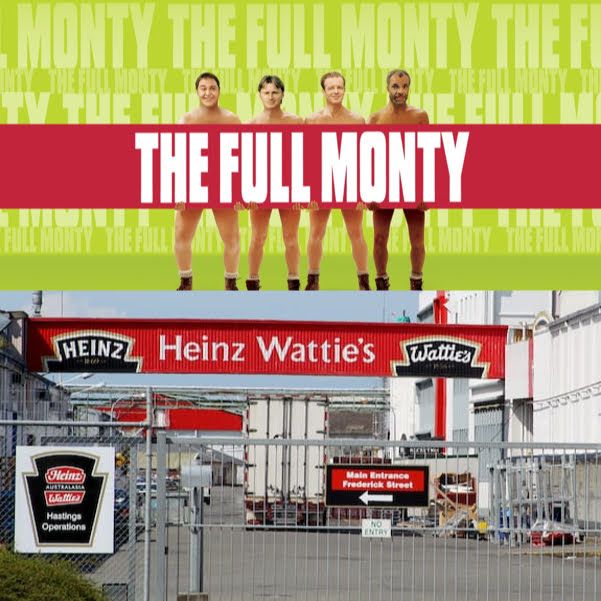
Welcome to Pop Culture PR. 350 jobs. Gone. Wattie’s vegetables, Gregg’s coffee. Gone. Canterbury growers of thirty years. Not gone, probably leaving. Cue Joe Cocker…
In The Full Monty, Sheffield’s steel industry collapses and leaves behind skilled, loyal workers with nowhere to go. They famously become strippers. It’s a classic movie, and it’s funny, heartbreaking, and a perfect parallel of what happens when economic forces hollow out a community from the inside.
Now look at our Watties workers without options, and with an admirable average length of thirty years’ service. One employee said it plainly, “There is nowhere else to go.”
Here’s the rub, this isn’t a Wattie’s (Kraft Heinz) story, it’s a supermarket story and the duopoly are the villains. And they’re far easier to identify compared to the Full Monty’s amorphous fight against the economic forces of Thatcherism.
Woolworths Supermarkets and Foodstuffs North Island Limited / Foodstuffs South Island control the shelf and set the price. It’s tremendous power, deciding what “value” looks like to a cost-of-living-crunched Kiwi shopper. And when local producers can’t compete with cheaper imported product, the duopoly doesn’t lose. The farmers do, the workers do and sadly, people in the regions do too.
Here’s where the communications lesson slaps. Behavioural science gives us the ‘availability heuristic’, it tells us that people judge risk and blame based on what comes to mind most easily (the same principle is applied to people grabbing what is cheap and easily reached on the shelf).
Right now, Watties owns this story. Their name is on the press release, the factory gate, and the redundancy letters. But the conditions that made this decision inevitable were built over years in supermarkets, in ranging decisions, in price signals that quietly told New Zealand shoppers that local wasn’t worth the premium.
That’s a framing problem for the duopoly. Every time an iconic brand folds, the public narrative gets a little easier to write. Cheap imported product on the shelf. Empty factory in Christchurch. The dots are easy to connect and once consumers connect them, the optics won’t be fixed with loyalty points campaigns.
PR ProTip
Silence is complicit. The duopoly’s absence from this conversation is itself a comms choice (and not a smart one). When you control the shelf, you own a share of every story about what disappears from it. Someone better get ahead of the framing or someone (maybe me) will do it for you. Because unlike The Full Monty, this show doesn’t end with a standing ovation.
