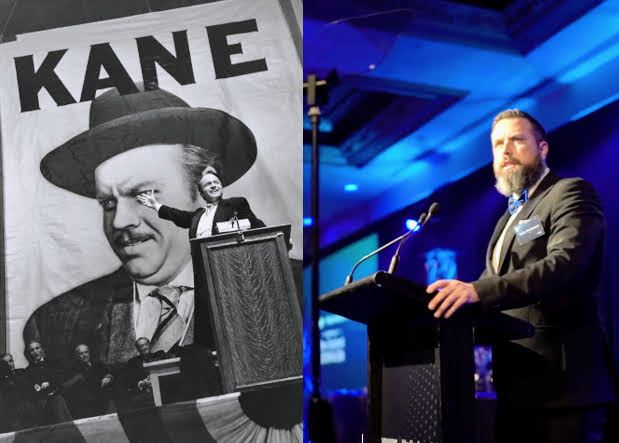
In Citizen Kane, Charles Foster Kane starts as an idealist with money and a megaphone. He buys a newspaper to tell the truth. Slowly the platform becomes the point, the reach becomes the identity, and the man “just asking questions” ends up pushing his own increasingly detached version of reality.
Enter Seeby Woodhouse, our tech founder (and the naming sponsor of New Zealand’s truth-in-journalism awards) who shares Holocaust denial content. He also accumulated a million plus social media following that most companies would kill for.
Unfortunatley the algorithm did what algorithms do. It seems to have weaponised his attachement to being online, nudging him one click or repost at a time, from festivals and tech content into antisemitic conspiracy theories. And then, almost suddenly, the gap between his platform and his sponsorship became impossible to ignore.
His defence was pure Kane. “Me posting something is not me being pro or anti, merely me saying hey look at this thing I found.” Kane’s equivalent was “I don’t talk, I print it.” Neither man wanted to own what they were amplifying. Both amplified it anyway.
To his credit, Woodhouse produce a clean apology without caveats. That part he got right.
Here’s the comms plot twist. The News Publishers’ Association terminated the sponsorship loudly and on principle, a pro move. But! Woodhouse and Voyager Internet Ltd had already decided not to renew. The NPA was getting dumped regardless, so they made a smart, decisive call and got ahead of it.
Their statement was precise and almost certainly written with the contract’s “moral turpitude clause” or “reputational clause” open on the desk. I may or may not have done a little litigation support on similar matters in the past..
I digress, and I also bet the NPA strategy was to create distance, enhance the show’s reputation, and advertise the available sponsorship, all while keeping the cash. Colour me impressed.
Kane’s tragedy wasn’t that he lost his way. It’s that everyone around him let him. The NPA didn’t make that mistake and they turned a quiet commercial loss into the best possible PR for a new naming sponsor. The space isn’t just open. It’s freshly polished and sitting pretty.
PR ProTip:
Getting dumped is bad. Getting ahead of being dumped is Strategy and Reputation Management. The NPA converted an awkward sponsorship exit into a values statement in front of every journalist in New Zealand, two weeks before their flagship ceremony. Whoever signs on next doesn’t just get naming rights. They get the halo of replacing the one dropped for sharing Holocaust denial content.
In Corporate Communications, that’s a remarkably clean brief to take to market.
Hat tip to David Farrier at Webworm for breaking this one.
